University of Tennessee, Knoxville, logo with a power T on an orange background on the right side.

AI Tennessee

  • Research Areas
  • Faculty
  • Education
  • AI TECHX
  • Centers of Excellence
  • About
  • News
  1. Home
  2. Research Areas
  3. AI Systems

AI Systems

Bridging AI and real-world challenges to drive efficiency and opportunity 

A portrait of Tobechukwu Nwabueze {head}University of Tennessee.
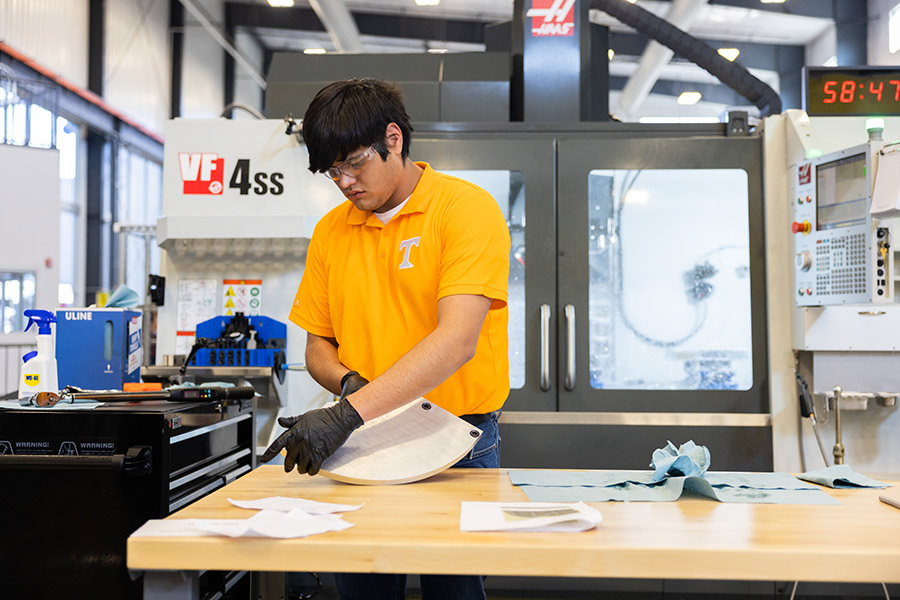
Ryan Garcia machines the top left quadrant of the SEC logo made by UT’s team during the inaugural SEC Machining Competition held at the University of Tennessee’s new Manufacturing and Design Enterprise in Hardin Valley, Tennessee.
Graduate student Mengjun Wang installs a Light Detection and Ranging (LiDAR) sensor on a robot dog as part of her research at the Gate 21 amphitheater at the University of Tennessee, Knoxville.

UT researchers in AI systems form the bridge between the fundamentals of AI—such as the computing architectures, statistical models, and algorithms that undergird machine learning—and positive outcomes for science, industry, and humanity.

Faculty design and build intelligent systems by coordinating the interactions between distinct AI elements such as machine learning pipelines, autonomous agents, edge AI, and AI-driven simulations. Researchers continue to optimize these systems for accuracy, efficiency, flexibility, and scalability, allowing them to transform workflows, enable process efficiency, and shape decision-making in applications from astronomy to zoology.

Graduate student Mengjun Wang walks a robot dog with an additional arm installed across Phillip Fulmer Way with Pedestrian Walkway in the background at the University of Tennessee, Knoxville.

UT’s Approach

UT researchers are integrating AI, machine learning, high-performance computing, and cloud platforms to tackle challenges in large-scale data distribution, storage, and computation, making AI workflows faster, more efficient, and more trustworthy. They are advancing autonomous systems across domains—from globally connected microscopy networks to air mobility to autonomous driving models that improve safety and reduce congestion. In agriculture, faculty combine computer vision, Internet of Things devices, and deep learning to strengthen food security with farm-specific digital twins, robotic pest monitoring, and automated pollination systems. In health and human services, they are developing socially assistive robots for dementia care, AI-enabled surgical systems, and diagnostic tools for conditions like atrial fibrillation. By uniting machine learning frameworks, physical mechanisms, and control systems, UT is creating intelligent robots capable of operating in unstructured environments, expanding the reach of AI into discovery, mobility, agriculture, and health care.

“UT has moved quickly and early in the emerging high-potential field of fully automated materials synthesis. The university has invested in our work building AI-enabled systems and workflows. With these unique operational capabilities, UT can truly make an impact on the state, country, and world.”

—Sergei Kalinin, Weston Fulton Professor of Materials Science and Engineering, UT; Chief Scientist, AI/ML for Physical Sciences, Pacific Northwest National Laboratory
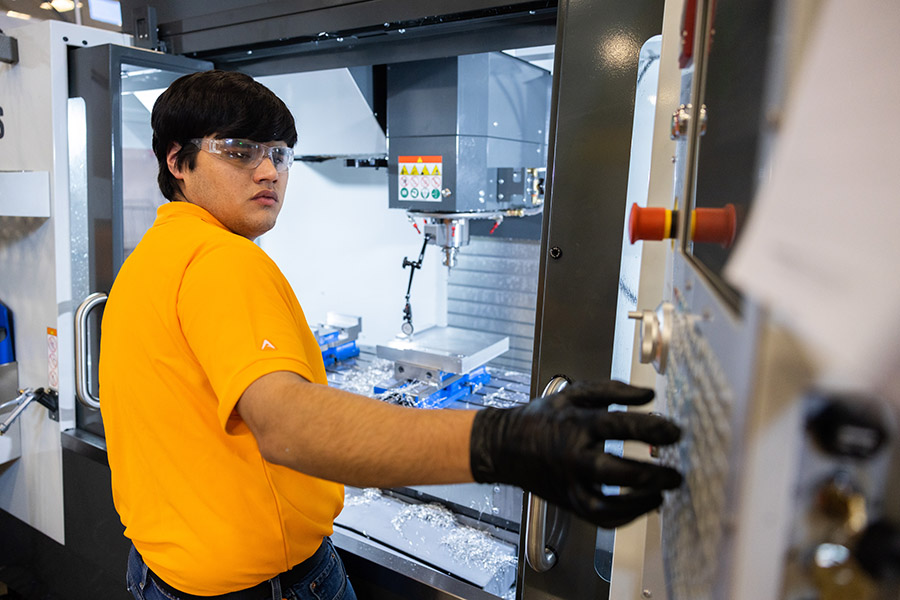

Ryan Garcia machines the top left quadrant of the SEC logo made by UT’s team during the inaugural SEC Machining Competition held at the University of Tennessee’s new Manufacturing and Design Enterprise in Hardin Valley, Tennessee.
Students work in the Grid Visualization Lab inside the Min H. Kao Department of Electrical Engineering and Computer Scienceat the University of Tennessee, Knoxville.
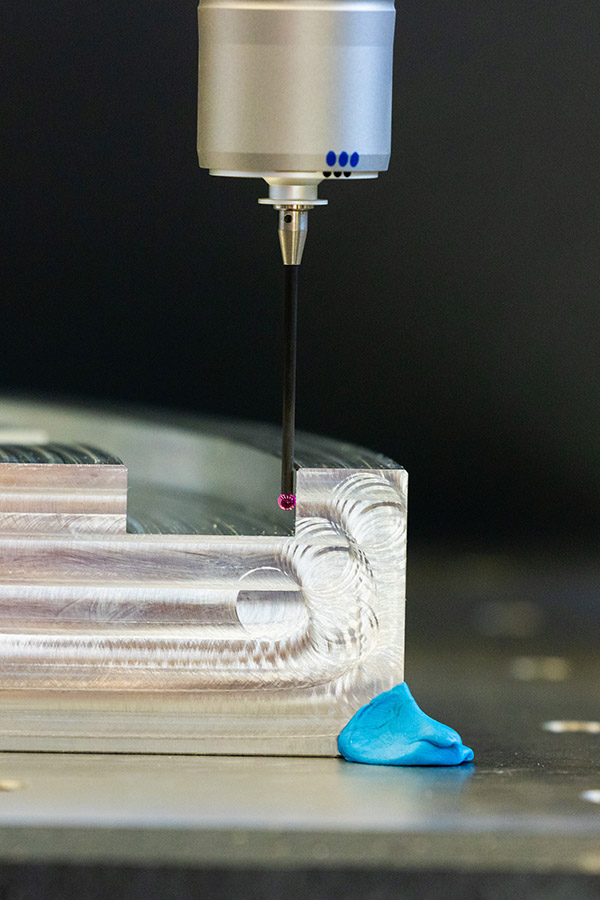
A detail photo of a Zeiss machine evaluating UT’s top left quadrant of the SEC logo during the inaugural SEC Machining Competition held at the University of Tennessee’s new Manufacturing and Design Enterprise in Hardin Valley, Tennessee.
PhD student McKensie Nelms works with a farm bot in the Smart Agriculture Lab in the Biosystems Engineering and Soil Science building at the University of Tennessee, Knoxville.
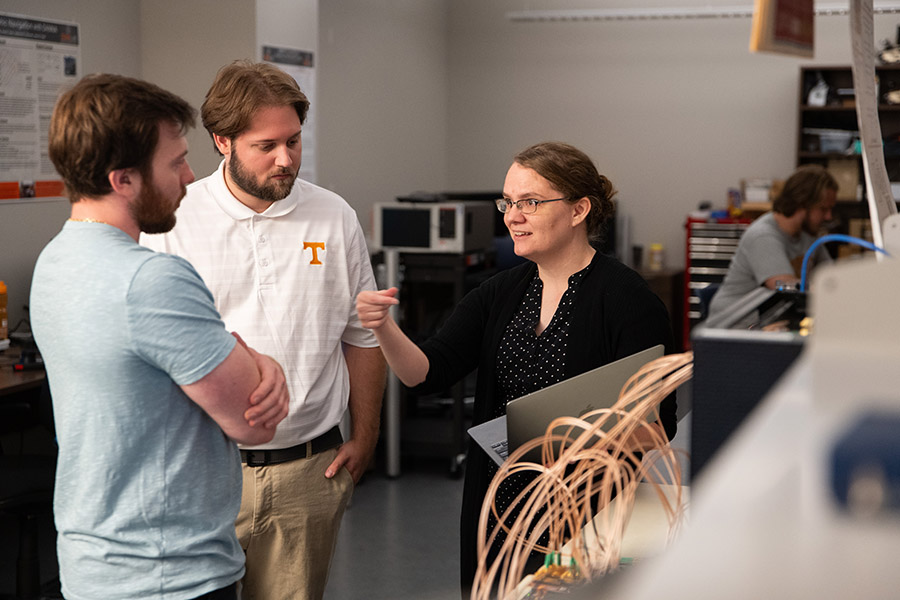
Assistant Professor Catherine Schuman speaks to graduate students in a neuromorphic computing lab in the Min H. Kao Electrical Engineering and Computer Science Building at the University of Tennessee.

Highlights

AI microscope In the Department of Materials Science and Engineering at the University of Tennessee, Knoxville.

Kalinin’s AI Microscopist Accelerates Nanoscale Material Characterization

With support from the US Department of Energy, Sergei Kalinin’s team launched a new AI-enabled workflow integrating machine learning, high-performance computing, and advanced microscopy. The workflow can gather useful data up to 100 times faster than conventional methods. 

Learn more about this research.

A surgical robot that is part of a Advanced Research Projects Agency for Health project.

Surgical Robot Project Receives Up to $12 Million in ARPA-H Funding

Caleb Rucker is co-principal investigator in a multi-institutional project to create a surgical robot capable of performing an entire surgery without human intervention. Rucker is leading a UT team in developing computational models to inform the automated surgery system. 

Learn about this landmark project.

Zhenbo Wang, University of Tennessee, Knoxville Associate Professor Zhenbo Wang in the Department of Mechanical, Aerospace and Biomedical Engineering.

Wang Investigates Autonomous Vehicle Control for Advanced Air Mobility Systems

Zhenbo Wang’s lab is developing and testing a novel airway system coupled with adaptive operational rules and control schemes. They are devising algorithms to facilitate autonomous control, adaptability, and optimal decision-making based on real-time factors.  

Learn about Wang’s vision for air mobility systems.

Michela Taufer, the Dongarra Professor in the Min H. Kao Department of Electrical Engineering and Computer Science (EECS) at the University of Tennessee, Knoxville and her Hih Performance Computing Group.

Group Combines High Performance Computing and AI to Advance Data Sciences

With a multiple-year award from the National Science Foundation, Michela Taufer is leading research to make developing tailored neural networks faster and more efficient. Improving neural networks in these ways will drive greater efficiency in diverse AI systems with data-based decision-making at their core.

Learn more about this research.

A detail of the top left quadrant of the SEC logo made by UT’s team during the inaugural SEC Machining Competition held at the University of Tennessee’s new Manufacturing and Design Enterprise in Hardin Valley, Tennessee.

Facilities & Initiatives

Faculty study and build AI systems in state-of-the-art facilities on and off campus. Centers and research groups receive support from and partner with organizations including the National Science Foundation, the US Department of Energy, the US Department of Transportation, and industry leaders.  

  • Center for Materials Processing 
  • Center for Nanophase Materials Sciences at Oak Ridge National Laboratory 
  • Infrastructure for Scientific Applications and Advanced Computing (ISAAC) 
  • Institute for Advanced Materials and Manufacturing  
  • Materials Research Science Center, Center for Advanced Materials and Manufacturing 
  • Oak Ridge Leadership Computing Facility 
Mahshid Ahmadi works with students inside her lab at the Institute for Advanced Materials and Manufacturing building at the University of Tennessee, Knoxville.

Our Researchers

  • Rigoberto Advincula

    Associate Professor, Chemical and Biomolecular Engineering

    Computation, simulation, theory, cell biology, immunology, intracellular transport, synthetic biology, systems biology, biomembrane, cytoskeleton, nanoparticle, biophysics, machine learning

  • Sergei Kalinin

    Professor, Materials Science and Engineering

    Physics-based machine learning, autonomous research, single-atom fabrication, scanning probe microscopy, scanning transmission electron microscopy

  • Fei Liu

    Fei Liu

    Assistant Professor, Electrical Engineering and Computer Science

    Computational modeling, advanced control and AI, integrated real-time robotics system

  • Yilu Liu.

    Yilu Liu

    UT–ORNL Governor’s Chair for Power Electronics

    Power systems, smart grid, micro grid, infrastructure reliance, energy policy

  • Sai Swaminathan

    Sai Swaminathan

    Assistant Professor, Electrical Engineering and Computer Science

    Human-computer interaction, accessibility, ubiquitous computing, cyber-physical systems, human-robot interaction.

  • Michela Taufer

    Michela Taufer

    Professor, Mechanical, Aerospace and Biomedical Engineering

    High-performance computing, cloud computing, edge computing, reproducibility, AI-inspired workflows, AI-inspired data analytics 

  • Zhenbo Wang.

    Zhenbo Wang

    Assistant Professor, Mechanical, Aerospace & Biomedical Engineering

    Optimal control; convex optimization; machine learning, guidance, navigation, and control space systems; aerial vehicles; connected vehicles

  • Peng Zhao.

    Peng Zhao

    Associate Professor, Mechanical, Aerospace & Biomedical Engineering

    Battery safety, thermal management, low carbon fuels, advanced combustion strategy, engine-fuel interaction

See all ai systems Faculty

AI Tennessee

AI Tennessee Logo

Research Areas

AI for Education and Workforce Development
AI for Knowledge and Discovery
AI Systems
Applied AI
Fundamentals of AI

Research Gateways

UT Research supports five Gateways defining the university’s strategic priorities—AI Tennessee is one of them. Find out about the other four gateways here.

The university is recruiting top-tier faculty members to join two cluster hires, one in Foundational Artificial Intelligence and one in Science-Informed Artificial Intelligence.
X (formerly Twitter) logo. LinkedIn logo.

The University of Tennessee, Knoxville
Knoxville, Tennessee 37996
865-974-1000

The flagship campus of the University of Tennessee System and partner in the Tennessee Transfer Pathway.

ADA Privacy Safety Title IX